Krinides, Kavala, East Macedonia & Thrace
Tower of Orthopetra
or Tower of Dikili-Tash
| Location: |
| On a low wooded hill at the SE side of the town Krinides, in Kavala region |
| Region > Prefecture: |  |
| East Macedonia & Thrace Kavala | |
| Municipality > Town: | |
| City of Kavala • Krinides | |
| Altitude: | |
|
Elevation ≈ 68 m (Relative Height≈12 m) |
| Time of Construction | Origin | |
| 11th or 12th cent. | BYZANTINE  |
|
| Castle Type | Condition | |
| Ruined Tower |
In Ruins
|
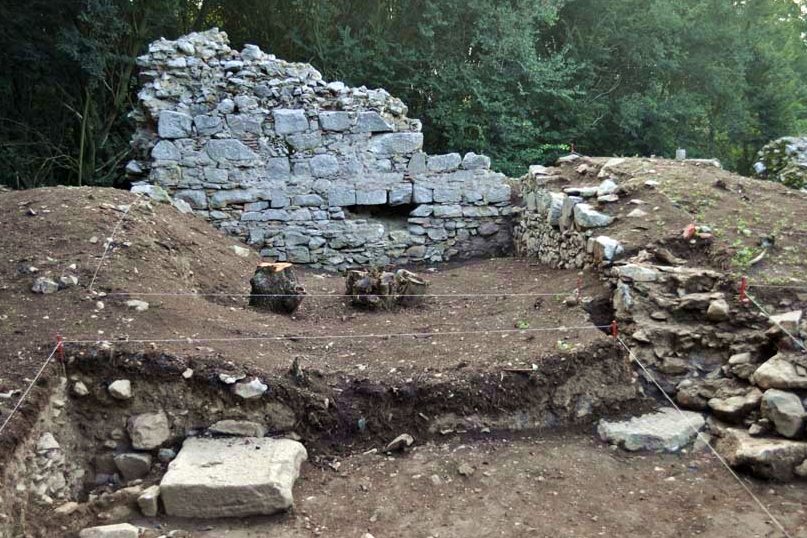
Remains of a Byzantine fortification and a tower within the archaeological site of Dikili-Tash, which is located on a low hill just outside the southeastern edge of the village of Krinides, north of Kavala.
The Name of the Castle
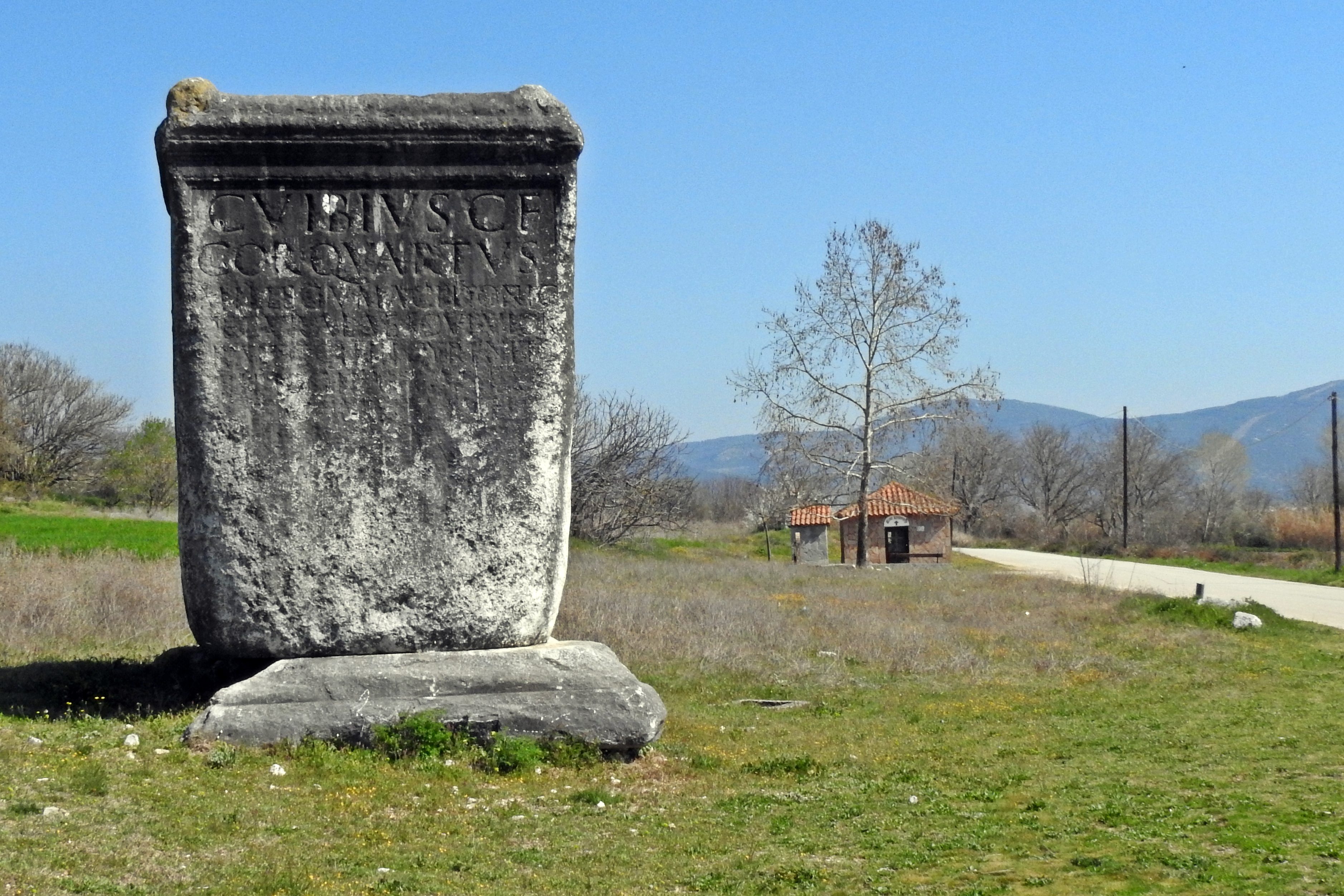
In the absence of an established name, we call the monument “Tower of Orthopetra” due to its proximity to the so-called “Orthopetra of Philippi”.
Orthopetra is an impressive monolith from the Roman era (photo 2), at least 8 meters high, located across the hill on the other side of the road.
The hill took its name from the monolith (which was a funerary monument). In the bibliography it is usually referred to as Dikili-Tash, which in Turkish means Standing Stone (Orthi Petra, in Greek).
“Orthopetra” is used for the monolith and more rarely for the archaeological site. We could have called the tower “Tower of Dikili-Tash”.
History
The settlement on the hill dates back to prehistoric times. It is the oldest Neolithic site in Eastern Macedonia and Thrace, and one of the most important in Greece and the Balkans.
Archaeological research is being carried out at the site by the French School of Athens in collaboration with the Athens Archaeological Society of Athens.
The mound of Dikili-Tash is formed from the rubble of the prehistoric settlement. The habitation in the area dates mainly to the Neolithic period (6400-4000 BC) and the Bronze Age (3000-1100 BC), while there are also a few finds from the Hellenistic and Roman periods.
During the Byzantine period, there does not seem to have been a settlement here, there was only the tower and the small fort, which apparently served as a bastion of the large Castle of Philippi on the mountain above, but also as a watchtower for the road that passes under the hill connecting Philippi with Christopolis (modern Kavala). This road was a branch of the Via Egnatia.
The masonry and the form of the tower are indications for dating its construction to the Middle Byzantine period, and specifically the 11th or 12th century. It was apparently built after the completion of the Byzantine fortification of the Acropolis of Philippi, which is dated around the end of the 10th century.
Around the tower, rubble was found from buildings that were newer than the tower. Material from the tower had been used for the construction of these buildings, since the rubble consists of bricks, tiles and fragments of corner stones that undoubtedly come from the tower (in second use). Among this rubble was found a bronze coin of Michael II Komnenos Doukas, who was Despot of Epirus in the mid-13th century. From this find we conclude that the tower was destroyed – for some reason – already in the 13th century.
Structure, Fortification & Buildings
At the top of the Dikili-Tash hill, the foundations of a small rectangular fortification enclosure are located, the eastern corner of which is occupied by the tower on this page.
The western side of the tower is completely destroyed, while its eastern and southern sides are preserved up to a height of 2 meters.
The tower was square with a side length of 9.25m. The thickness of the walls is 1.87m and the internal square space
has a side of 5.50m.
Reused corner stones were used in the foundations and the walls, some of which date back to the Roman Era.
Sources
- Ευάγγελος Παπαθανασίου, Αρχαιολογικόν Δελτίον, τεύχος 50/Β2-1995, σελ. 674
- Pascal Darcque, Χάιδω Κουκούλη-Χρυσανθάκη, Δήμητρα Μαλαμίδου, Ζωή Τσιρτσώνη, Σουλτάνα-Μαρία Βαλαμώτη, «Προϊστορικός Οικισμός Φιλίππων - Ντικιλί-Τας: η ανασκαφή του 2010», ΑΕΜΘ, τεύχος 24 - 2010, σελ.453.
- Website ΝΤΙΚΙΛΙ ΤΑΣ Ιστορικη εποχη : Βυζαντινη περιοδος
- Research: Charalampos Papadopoulos
| Access |
|---|
| Entrance: |
| The site is fenced anf the access is not possible. |